
What is Tooth Decay, and How Does it Happen? A Complete Guide

That sudden, sharp sensitivity when you drink ice water. A dull, throbbing ache that wakes you up at night. Or maybe you’ve spotted a small, dark pit on a molar you can’t ignore.
These are the classic warning signs of tooth decay, also known as dental caries or cavities. It’s the single most common chronic health condition worldwide, but the good news is: it is almost entirely preventable and highly treatable, especially when caught early.
Ignoring decay doesn’t just lead to more pain; it leads to infection, complex procedures, and even tooth loss. Understanding the process is the first step toward prevention and seeking the right help. If you’re facing these symptoms, your priority becomes finding the best dentist for tooth decay in Chanda Nagar to stop the damage before it worsens.
At Sri Sai Dental Hospital, conveniently located right beside the Chandanagar bus stop, we are dedicated to both treating and educating. This guide breaks down exactly what tooth decay is, the science of how it happens, and the advanced treatments we offer.
What is Tooth Decay? (A Snippet-Ready Answer)
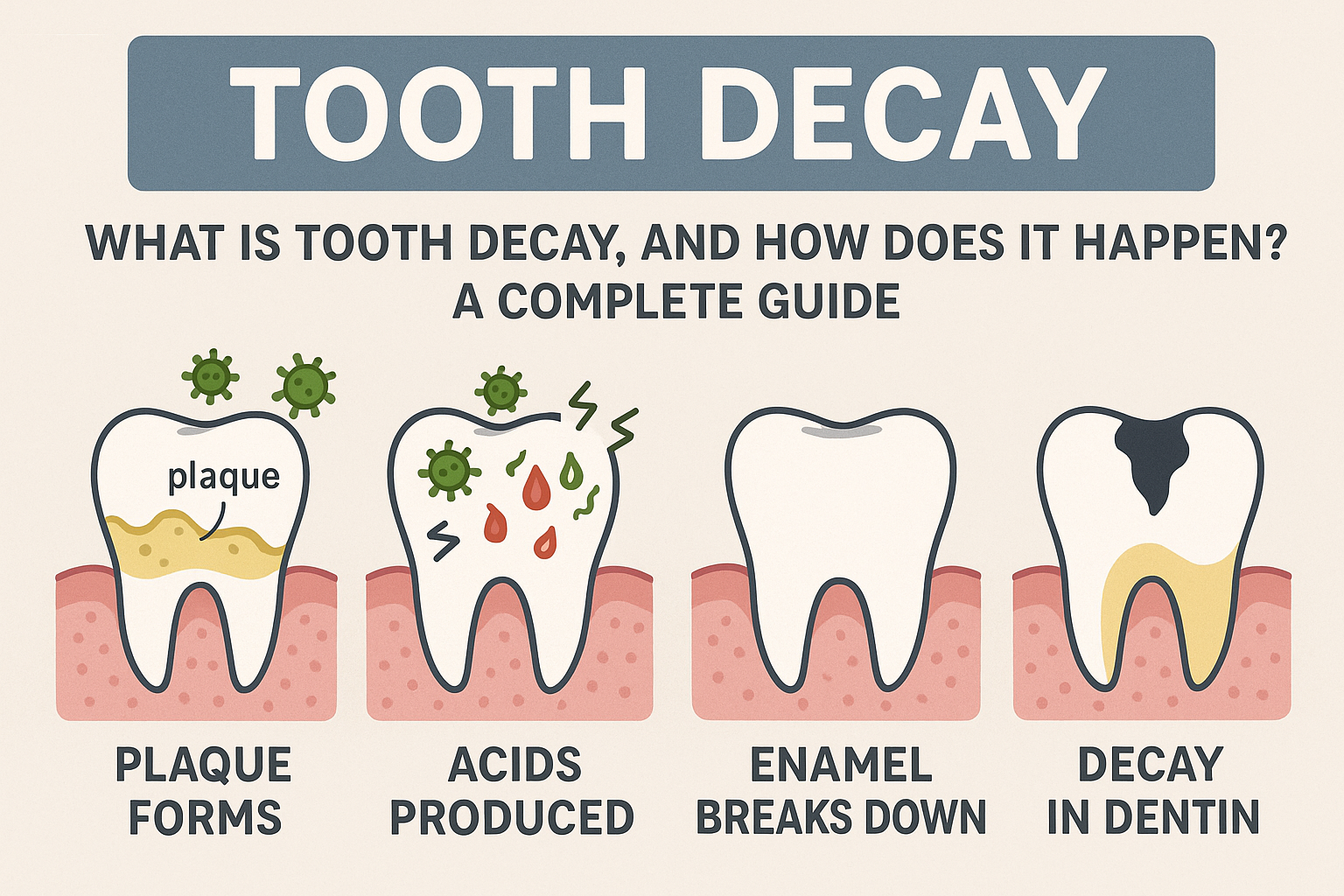
Tooth decay is the destruction of your tooth’s hard tissues (enamel and dentin) caused by acids. These acids are produced by specific bacteria living in plaque—a sticky, colorless film that constantly forms on your teeth.
When you consume sugary foods or carbohydrates, these bacteria feast on the sugar and release acid as a byproduct. This acid attack slowly dissolves vital minerals from the tooth’s surface, eventually creating a permanent hole known as a cavity. If left untreated, this hole deepens, progressing from the outer enamel layer into the softer dentin layer, and finally into the sensitive inner pulp (the nerve) of the tooth.
The Science of a Cavity: How Does Decay Actually Happen?
A cavity doesn’t just appear overnight. It’s a slow process that happens in a few key steps:
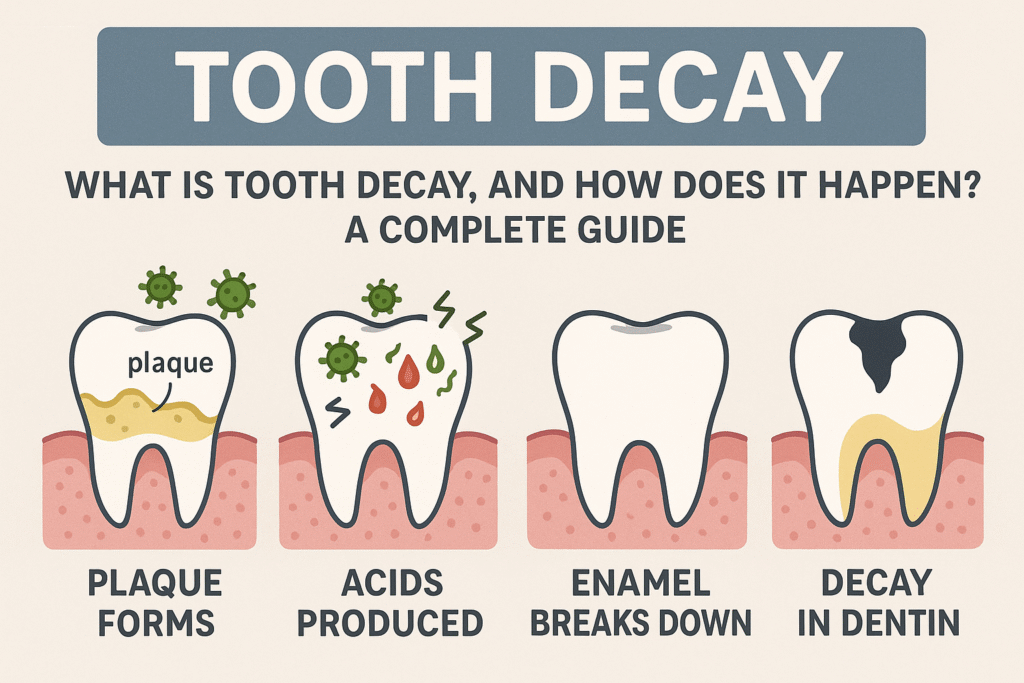
- The Culprit (Plaque): Your mouth is a complex ecosystem filled with bacteria, both good and bad. When harmful bacteria mix with food particles (especially sugars and starches) and your saliva, they form plaque. This sticky film clings to your teeth, especially in hard-to-reach areas.
- The Acid Attack: The bacteria within the plaque consume the sugars you eat. Their waste product, unfortunately, is acid. Every time you eat a sugary snack or drink a soda, you are feeding these bacteria, and they respond by releasing damaging acids onto your teeth for about 20 minutes afterward.
- Demineralization: This acid is powerful. It begins to attack the hardest substance in your body: your tooth enamel. The acid strips the enamel of vital minerals like calcium and phosphate. This process is called demineralization.
- The Cavity: Over time, repeated acid attacks weaken a spot on the enamel until it collapses, creating a physical hole. The decay has now breached the gates. Once it’s through the enamel, it reaches the much softer layer beneath, the dentin, where the decay process accelerates rapidly.
The 5 Stages of Tooth Decay (And When to Worry)
Understanding the stages of decay helps you understand why catching it early is so critical. Treatment is simpler, less invasive, and less expensive in the early stages.
Stage 1: White Spots (Demineralization)
Before a true cavity forms, you may see small, chalky white spots on your teeth. This is the first sign of mineral loss. You will likely feel no pain at this stage.
- Can it be fixed? Yes. This stage is the only one that is reversible. At Sri Sai Dental Hospital, we can treat these spots with a professional fluoride treatment to help the enamel remineralize and “heal” itself.
Stage 2: Enamel Decay
The decay has broken through the top surface of the enamel. The white spot may start to turn brownish or black. A cavity has officially formed.
- Can it be fixed? The damage is now permanent and the hole will not repair itself. However, it can be easily treated with a dental filling.
Stage 3: Dentin Decay
Once decay gets past the enamel, it hits the dentin. This layer is much softer and has tiny tubes that connect directly to the tooth’s nerve. This is when sensitivity starts. You’ll feel sharp zings from hot, cold, or sweet things. The decay process speeds up significantly here.
- Can it be fixed? Yes. This almost always requires a dental filling, or a larger filling called an inlay or onlay, to clean out the decay and protect the tooth.
Stage 4: Pulp Damage
The decay has now reached the center of the tooth (the pulp), which contains all the nerves and blood vessels. When bacteria invade the pulp, it becomes infected, inflamed, and swollen (this is called pulpitis). Since the pulp is trapped inside the hard tooth, this pressure causes significant, often throbbing, pain.
- Can it be fixed? A simple filling is no longer enough. To save the tooth, this stage requires a root canal treatment.
Stage 5: Abscess
If the pulp infection is left untreated, the infection spreads from the pulp down to the root tip and into the surrounding jawbone. This forms a painful, pus-filled pocket called an abscess.
- Can it be fixed? An abscess is a serious medical emergency that can spread infection throughout the body. Symptoms include severe pain, swelling in the face or gums, fever, and a bad taste in the mouth. Treatment involves draining the abscess and performing a root canal. In severe cases, the tooth may need to be extracted.
Solutions for Every Stage: Professional Tooth Decay Treatment in Chanda Nagar
The treatment we recommend at Sri Sai Dental Hospital depends entirely on the stage of the decay. Our goal is always to save your natural tooth using the most conservative method possible.
For Stage 1: Professional Fluoride Treatment
For early-stage white spots, we apply a high-concentration fluoride varnish or gel. This professional-grade treatment remineralizes the enamel, effectively stopping and reversing the decay process before a cavity forms.
For Stages 2 & 3: Dental Filling in Chanda Nagar
This is the most common restorative treatment for cavities. The process is straightforward and comfortable:
- We gently numb the area so you feel nothing.
- Our dentist carefully removes the decayed (soft) portion of the tooth.
- The space is thoroughly cleaned and disinfected.
- We fill the clean cavity with a durable, tooth-colored composite resin, which we shape and polish to look and feel exactly like your natural tooth. This stops the decay and restores the tooth’s original shape and function.
For Stage 4: Root Canal Treatment in Chanda Nagar
When the nerve is infected, a filling won’t solve the problem; the pain and infection will remain. A root canal treatment is a highly effective, tooth-saving procedure. Contrary to myth, modern root canals performed by our skilled team are not painful—in fact, they are the procedure that gets you out of pain.
During the procedure, we remove the infected nerve (pulp), meticulously clean and disinfect the inside of the tooth’s canals, and seal the space to prevent re-infection. The tooth is then typically protected with a durable dental crown to restore its full strength. Choosing a root canal is far superior to extracting the tooth.
For Stage 5: Abscess Drainage & Extraction
If the tooth is too damaged to be saved or the infection is too severe, extraction may be the only option to remove the source of infection and protect your overall health. We always discuss comfortable replacement options, like dental bridges or implants, to maintain your bite and smile.
Why We Are the Best Dentist for Tooth Decay in Chanda Nagar
Finding the right cavity treatment in Chanda Nagar means trusting your dental team to be skilled, transparent, and compassionate. At Sri Sai Dental Hospital, we are committed to being that clinic for you.
- Expert Diagnosis: Our doctors use advanced diagnostic tools, including low-radiation digital X-rays, to detect decay at its absolute earliest stage—when it’s invisible to the naked eye and easiest to treat.
- Comprehensive Care Under One Roof: We are not just a filling clinic. Whether you need a simple preventative check-up, an advanced root canal treatment in Chanda Nagar, or a complete dental restoration, our facility is equipped to handle every stage of your dental health.
- Patient Comfort: We understand dental anxiety is real. Our team is trained in gentle, compassionate care, ensuring your procedure is as comfortable and pain-free as possible. We explain every step, so you are always in control.
- Unbeatable Location & Accessibility: We make dental care easy to access. Our clinic is located on the 1st & 2nd Floor on the Main Road, Mumbai Hwy, right beside the Chandanagar bus stop. We are perfectly situated to serve the communities of Chanda Nagar, Jawahar Colony, and all surrounding areas.
Patient Testimonial: “I was in terrible pain and needed an urgent root canal. The team at Sri Sai Dental saw me the same day. They were professional, gentle, and explained everything. They truly are the best in Chanda Nagar.” – P. Sandeep, Chanda Nagar.
How to Prevent Tooth Decay (The Best Treatment is No Treatment)
While we are experts at fixing decay, we would rather help you prevent it entirely.
- Brush Correctly: Brush twice a day, for two full minutes, using a fluoride toothpaste.
- Floss Daily: This is non-negotiable. Flossing cleans the 40% of your tooth surface that your brush simply cannot reach, preventing decay from starting between your teeth.
- Watch Your Diet: Limit sugary and acidic foods/drinks (sodas, juices, energy drinks, sticky sweets). When you do indulge, drink water immediately afterward to rinse your mouth.
- Stay Hydrated with Water: Saliva is your body’s best natural defense against acid. Drinking plenty of water keeps your saliva flowing.
- Don’t Skip Your 6-Month Check-up: This is the most important tip. Visit Sri Sai Dental Hospital every six months. A professional cleaning removes hardened plaque (tartar) that you can’t remove at home, and our exams spot problems when they are tiny, painless, and affordable to fix.
Don’t Wait for the Pain: Book Your Appointment Today
Tooth decay is a progressive disease, moving from a silent white spot to a painful, dangerous abscess. That small twinge of sensitivity you feel is your body’s early warning system. Please don’t ignore it.
Whether you are due for a check-up, need an expert opinion on a toothache, or require urgent tooth decay treatment in Chanda Nagar, our team is here to help. Stop searching and contact the experts at Sri Sai Dental Hospital directly.
Call Us Today: 040 2303 5706
Visit Our Clinic:
SRI SAI DENTAL HOSPITAL 1st & 2nd Floor, Main Road, Mumbai Hwy, beside Chandanagar bus stop, Jawahar Colony, Chanda Nagar, Hyderabad, Telangana 500050